

Bryn Morgan-Hughes shares his experience as Artist/Maker in Residence at Glen Dye
Written by Bryn Morgan-Hughes


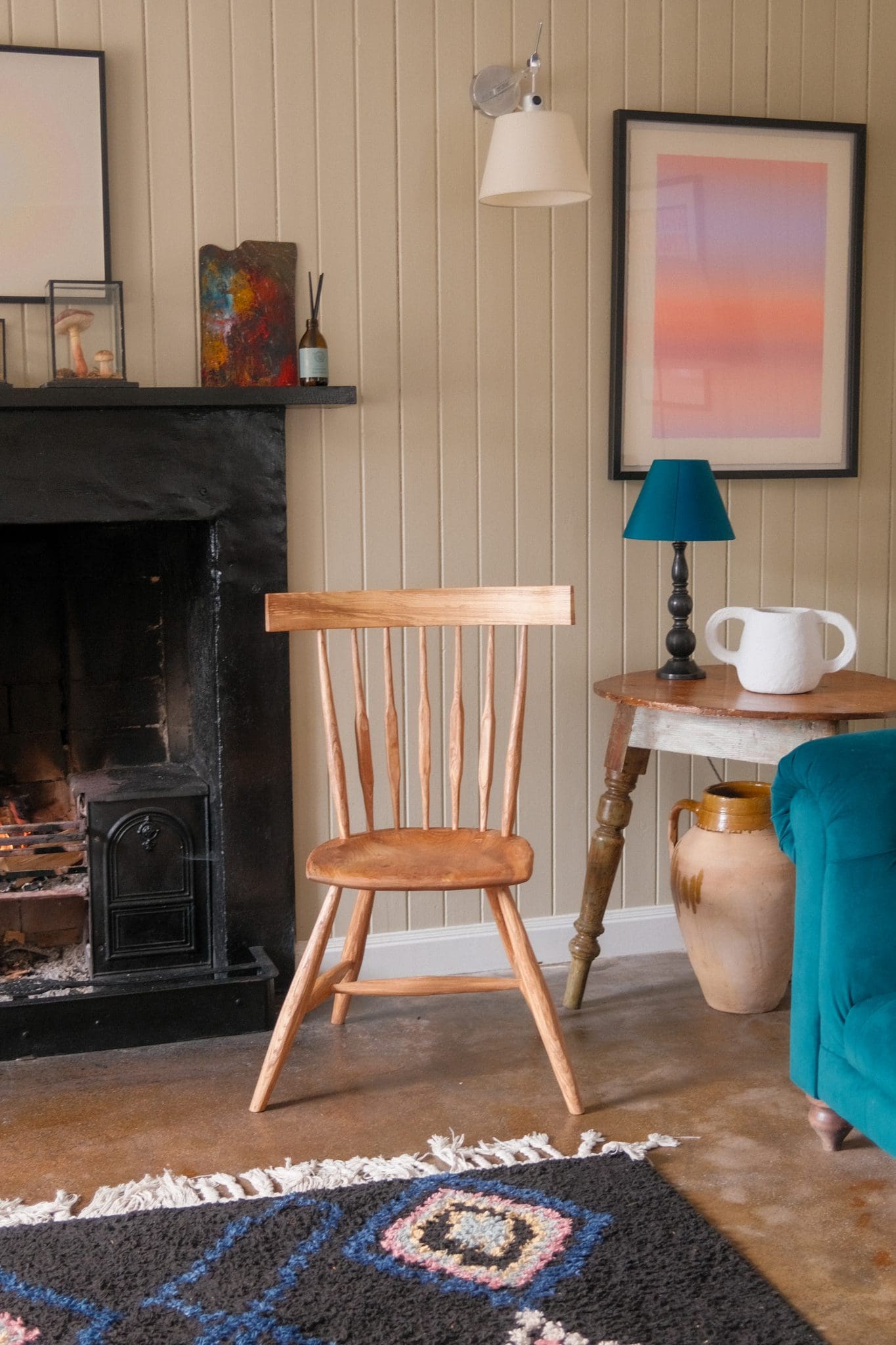
In February 2025, Bryn Morgan-Hughes made good on his promise to create two astonishing chairs from Glen Dye ash (amongst other trees). He very generously gave us these chairs which ooze not only superficial beauty and strength but also the deepest and purest provenance imaginable.
They have real soul; we find them truly thrilling.
In return for the chairs, the story and the connection to the place, we welcomed Bryn to Cuttieshillock, to stay for three weeks of making, exploring, eating, listening… as part of our Artist in Residence series.

Here’s Bryn’s sotory, in his own (beautiful) words.
The last evening of my stay at Glen Dye is one that I will never forget. After dropping off the completed chairs (to the lovely Audrey down at the office) and returning the Cuttieshillock outbuilding to its cosy state; woolen blankets in comfy armchairs, antique lighting, wall hangings and a beautiful wicker basket; almost unrecognisable compared to the last three weeks being covered in woodshavings, stacks of drying parts, tools strewn about and my shavehorse in the middle. I set out for a walk, up the pebble path past the wood-fired sauna and followed it along, around the dense conifer plantation.
It had been a stormy day with high winds and a fair bit of rain but it was now bright and you could sense the sun was going to provide one last blast before it set. Reaching the edge of the plantation, I was greeted by a gorgeous view of the valley and hills in the background; a classic Highland landscape. The sun had emerged just before it dropped below the back of Clachnaben and a rainbow formed behind me.
Thinking back about the daunting task I’d set myself of making three greenwood chairs in three weeks, the splitting of the burr ash and monster oak log down in the field with Neil (the seasoned and skilled estate joiner), the laborious but gratifying work I’d undertaken in the outbuilding and the journey that had led me to Glen Dye in the first place, I felt completely overwhelmed with a sense of joy in what I had made. A feeling that I previously thought could only be accomplished through an intense religious experience or perhaps dancing to the most euphoric music with a bit of chemical assistance.
The idea for this project had sprung where most good places do: on the bogs at work. My partner, Hinako, had sent me a message directing me to a post from Glen Dye about an open call for their artist residency programme up near Aberdeen; a trade of work for lodgings and a chance to create without boundaries or requirements. Having spent a lot of time up in The Highlands on family holidays, and desperate for a break from the grind of London, I knew I had to apply.
I’d moved down to London from Sheffield in 2020 to pursue my dreams (at the time) of cooking in their famed restaurants, foolhardy you might say, in a time when a lot of restaurants were shut due to social distancing guidelines. However, I found my feet and an establishment that was operating a takeaway service. Things gradually returned to normal and I was right in the mixer, on the line, cooking. I enjoyed the work for the most part, it was intense and you were always learning but as the story so often goes, I’d become burnt out by the long hours, lack of social life and oddly, poor diet – too many beers and takeaways after shift due to not wanting to cook more.
I’d always been interested in wood as a material and knew I enjoyed being on my feet and working with my hands so when I was offered an apprentice position at a cabinet making workshop in North London I jumped on it – a lot of sweeping, cleaning and sanding cemented my place there and I began learning the technical craft from some highly skilled old boys.
Almost everything in cabinet making is about precision and attention to detail, a stray mm here and there can make a huge difference. I found myself relishing this work but at the same time craving for more organic shapes, methods and materials than the straight and square work I was becoming accustomed to. In the evenings, I would carve spoons from workshop offcuts and build up my skills through end grain chopping boards, stools and benches. I then went down, as I often did, a YouTube rabbit hole of greenwood chair making; a historical craft with tales of ‘bodgers’ going out into the woods for weeks and returning with shedloads of handcrafted parts, split straight from logs and shaped while the wood is still green, following the wood fibres and its natural shape. Forms and practices that are probably one of the purest forms of woodwork but quite alien to the world of cabinetry.
The process reminded me of my time in a riotous but elegant pub kitchen where the talented chef/owner, Matthew, knew exactly where the ingredients came from and took them in their rawest form, utilising every part to create something delicious. I wanted to apply this same principle to my craft; focussing on provenance of material, taking it whole to allow for the most refinement without outside influence or other hands affecting the quality of produce and, combined with the precision of cabinetry make some beautiful but ergonomic chairs. When I sent that email, I’d never actually made a chair. Logs were, as you can probably imagine, quite hard to come by in London and there was certainly no way to take them home on the tube.
The residency programme seemed like an excellent opportunity to have access to green wood given the estate’s vast amount of trees so I thought why not give it a go. I fired off a quick email suggesting that I could make a chair using wood that had fallen during the massive winds they’d had in previous years and, to my surprise, they said yes….
Shit.
Now I had to work out how to do it.


There are a number of books on the subject, J. Alexander – ‘Making a Chair From a Tree’, being my first port of call. Mike Abbott has also written a number of books which are hard to get hold of but worth it for the knowledge inside. I also came across the works of Curtis Buchanan online and found he had created some tutorials on the practice of Windsor chairmaking. I revised these constantly, taking notes and making a recipe book of my own.
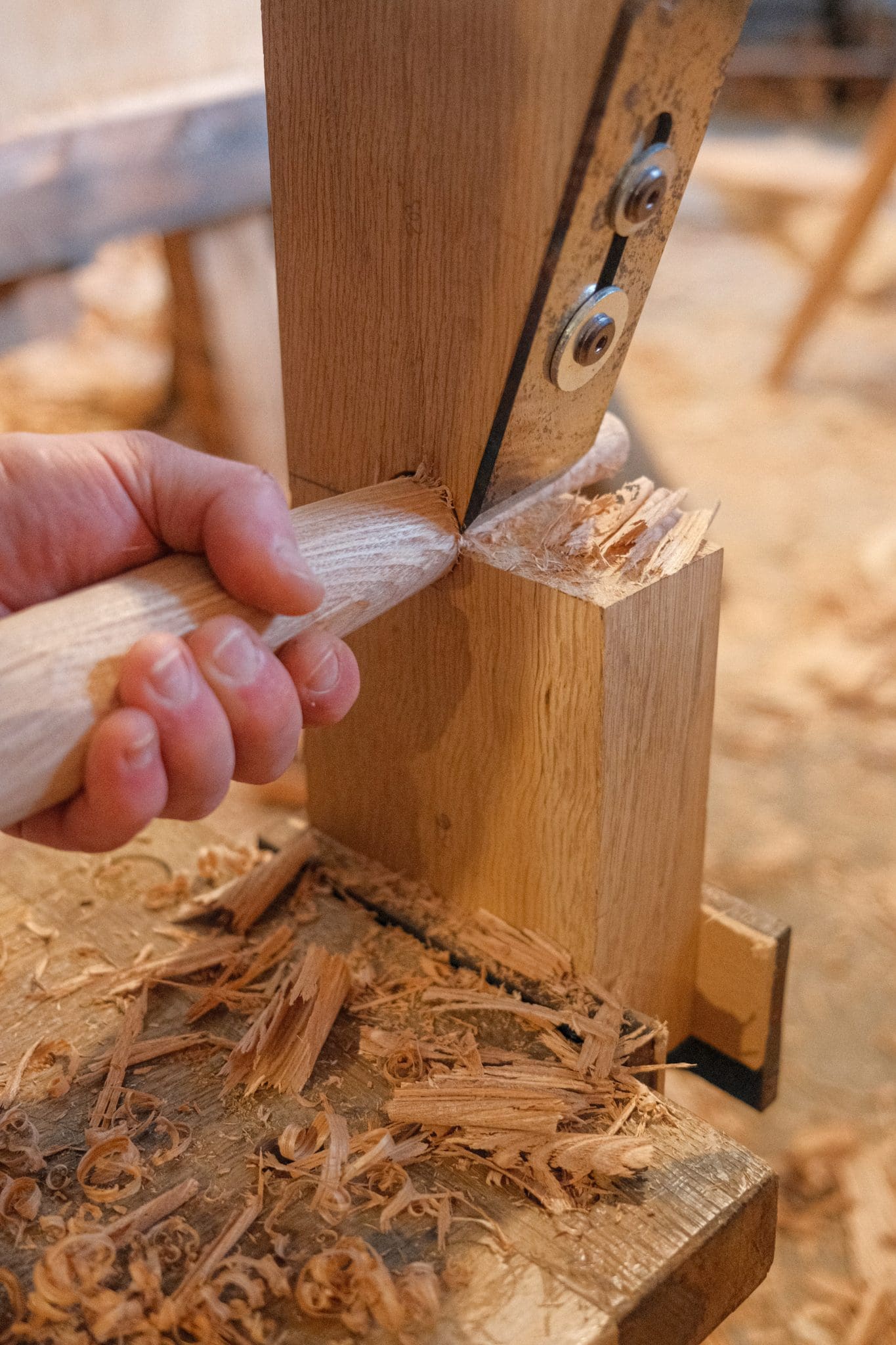
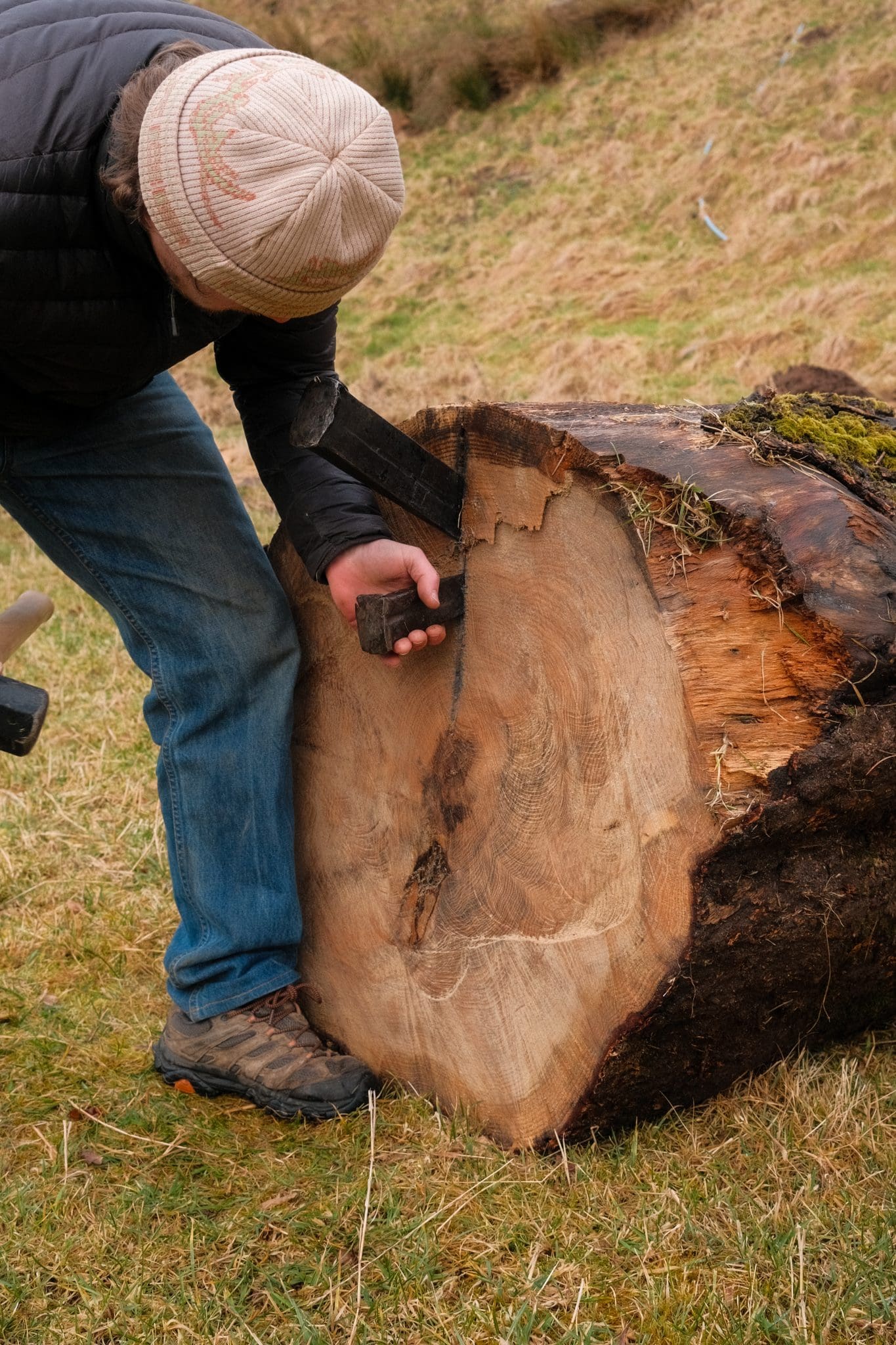
There are many stages to the process but of course it first starts with the log. It is split using a sledgehammer and wedges of various sizes and then with a froe, a medieval looking tool that allows you to control the direction of the split. Blanks are then prepared and shaped with a drawknife to form the various parts: legs, stretchers, spindles and back which is bent using steam. These are then dried to varying degrees depending on their position. The principle is that if a dry tenon goes into a wetter mortise, it will expand and become even tighter. For example, the centre of the leg is wrapped in cling film so it does not dry as much so when a hole is drilled in it to house the dry stretcher it creates a rock solid joint. The seat itself is made of kiln dried wood as it needs to be stable to house the different parts (I brought these with me to Glen Dye – a mix of elm and oak from British woodlands).
My first attempt was done in the garden of our flat in Finsbury Park (North East London), I’d managed to find a recently felled green oak log in Surrey Hills and, with the help of my good friend, big Lou, got it out the van and down the steps, narrowly avoiding squashing myself under it.
Six months later and with the confidence of the first chair under my belt, I made the drive up to Glen Dye. I arrived in the dark, following the steep windy road up over the top of the glen. I was filled with trepidation at what I was doing and why I had suggested this idea in the first place. I was also becoming increasingly concerned as I was struggling to see any hardwood trees through all the conifers.
I arrived at Cuttieshillock and instantly felt a lot calmer, the beautiful interior was so welcoming and I was very pleased to see a number of very fine examples of old Windsor chairs. I was given a warm greeting by Neil the following morning and he showed me around. When I voiced my concerns about the possible lack of hardwood, he reminded me that this is Scotland after all and there are conifers everywhere but that he did have a few hardwood logs in mind. The first of which was an enormous oak that previously stood very close to the Glen Dye Arms and had been blown over to the top of the hill, he then took me up into the woods where he splits all the timber that keeps the cottages on the estate warm, pointing out a few more modestly sized burr ash logs that he’d put to one side.
After some quick chainsaw work, a winch and a big old tractor, Neil had got the oak and ash down to the field below the office and I set about splitting it. He soon realised my inexperience due to my poor sledgehammer technique and only having a few wedges, but with a bit of coaching and lending a few of his own wedges, I got the logs open, halved, quartered and then eighths.
With a full van of split ash and oak I took the short drive back to Cuttieshillock and got my tools laid out, fire on and speaker plugged in to keep me company – sidenote – favourite three albums while chairmaking at Glen Dye:
● Cameron Winter, “Heavy Metal” (2024).
● Mount Kimbie, “The Sunset Violent” (2024).
I can’t listen to this album without mega chills now.
● Wunderhorse, “Midas” (2024).
Right, on we go.


The house itself feels so peaceful; there are no neighbours so it really does feel like the middle of nowhere. I found the isolation to be really conducive to the work. I’d wake up pretty early, get a coffee on, and then go out the front door and straight into the outhouse. Stopping for a quick lunch and a walk in the woods and then working on till late in the evening. The sauna provided a serious respite for tired joints and hands after work, sitting on the shavehorse and carving all day led to all manner of aches and pains.
For some reason, rather than just making one chair, I’d challenged myself to make two full size chairs for the estate and a small scale one for my one-year-old nephew, Bowie. This led to an intense schedule of carving and drying over 50 parts within a two week period, leaving the final week for assembly. I made a full chair worth of parts in oak but realised it would never dry in time so set these aside for assembly at a later date, I hope to get this up to the glen in future and put it in the Glen Dye arms, metres away from where the tree once stood.
I then turned my attention to the ash, it had the most stunning grain; the result of a fungal infection which created reds and orange hues, something I was not used to when compared with the pale, chalky timber I would see at work. This dried very quickly and the shavings made for great kindling for the fire which I lit every morning. I followed templates for the rough shape of the parts but then worked by eye to refine and bring the chairs together.
I was visited by my parents for the first weekend and Hinako for the second, it was a joy to share the experience with them and create some wonderful memories; attempting a very stressful steam bend with my dad (we can laugh about it now), grilling fresh prawns and steaks on the big green egg with Hinako and a walk up Clachnaben in the snow.
Without wishing to sound too corny, the only bad part was leaving. Returning to the normality of work, on site fitting some wardrobes I was struck that I had truly found my meaning and purpose, day in day out toiling on the chairs I had never felt such peace and was so properly in tune with my hands and my mind. It was a real privilege to be able to experience this feeling and I can’t thank Charlie, Caroline, Rhys and the rest of the Glen Dye team for helping me in this great adventure.
Words by Bryn Morgan-Hughes.
Follow his work on Instagram: @mrlogs_
 Bryn Morgan-Hughes shares his experience as Artist/Maker in Residence at Glen Dye
Bryn Morgan-Hughes shares his experience as Artist/Maker in Residence at Glen Dye from February 2025.
 On my culture radar this month for April
What’s new on the cultural radar for April 2025. Written by Charlie Gladstone. Including books, audio and music.